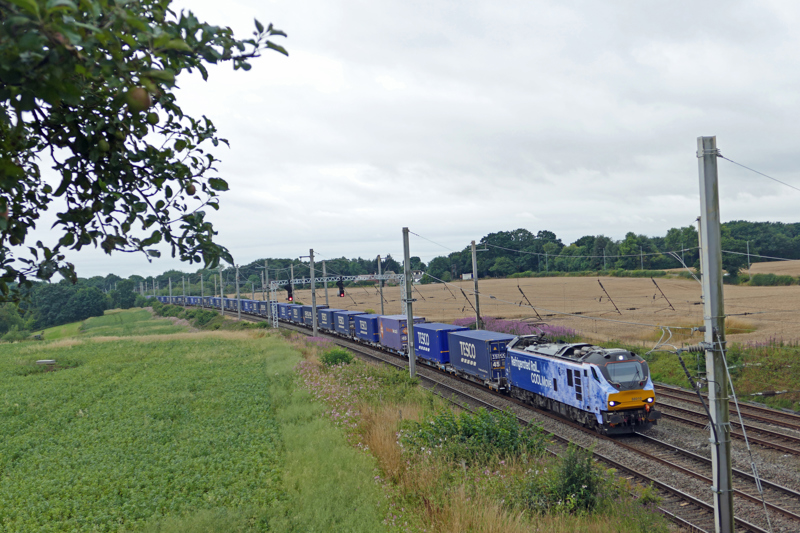
The UK Government target is to increase railfreight by 75% by 2050, with an annual growth of 7.5%.
Looking at the East Coast Main Line (ECML), however, the main source of business would have to be intermodal container traffic to the Midlands and the North East from the recently improved ports of Felixstowe and London Gateway.
Many of these trains pass through Peterborough, where there is a large new freight handling and operating centre with 7 lengthy sidings. However there is a unique restriction just 10 miles north of Grantham in the form of flat crossing of the ECML by the Nottingham to Lincoln Line. Though there have been several proposals for a grade separated junction and crossing none have been approved, mainly because the close proximity to the River Trent makes such projects technically difficult and costly.
The second bottleneck is a 2-track section of about 10 miles between Huntingdon and Peterborough which includes a 6-mile strech across fenland near Stilton which would be technically difficult to widen to 4-tracks.
Because of the obvious problems of running fast passenger express trains and relatively slow freight trains on the same track this is a major inhibition for long distance North-South freight movement.
It will therefore not be easy for Great British Rail to meet the government’s targets for railfreight unless significant investment is made right along the route of ECML to remove such bottlenecks. Any attempt to produce a vaguely parallel freight loop by improving – for example – stretches of the former Bethnal Green to Kings Lynn Railway (!) from the Barking Freightliner Terminal (for international connections) via Cambridge and thence to Peterborough, might look just about feasible on a map, but the various local upgrades that might be required would not be cheap either!